

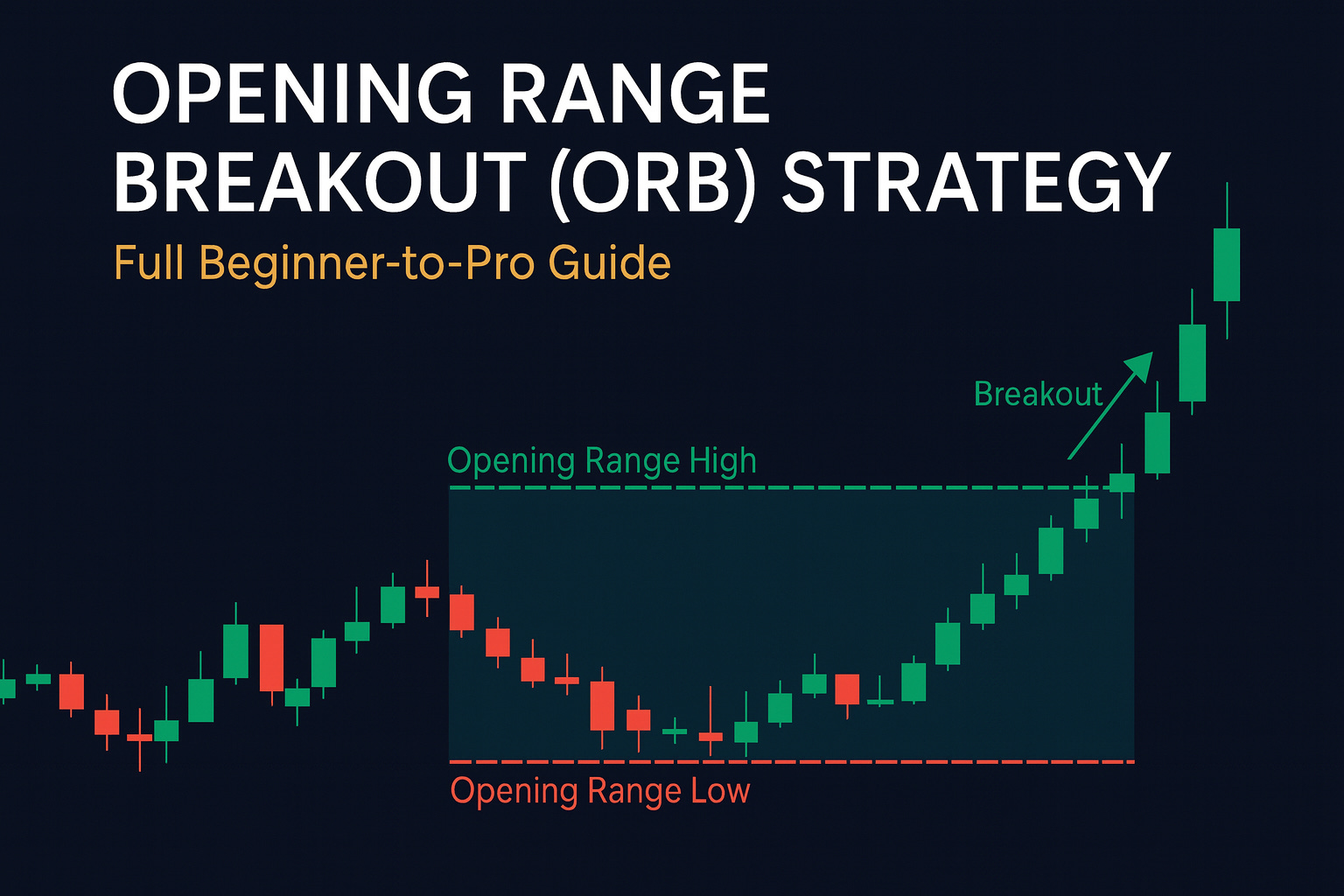

The Opening Range Breakout is one of the most reliable and psychologically simple trading frameworks you can use especially if you want structure, defined rules, and a repeatable edge without overcomplicating the chart.
This guide breaks down exactly how ORB works, how professionals trade it, how retail traders misuse it, and the statistical reality behind the “first 15 minutes” of any session.
By the end, you’ll know how to trade ORB like a system.
What Is the Opening Range?
The opening range is the price high and low formed during a predefined period at the start of the trading session. Most traders use one of the following:
0–5 minute range
0–15 minute range (most common)
0–30 minute range (used on slower markets)
Once that window completes, the market has created:
Opening Range High (ORH)
Opening Range Low (ORL)
When price breaks above ORH → potential long setup. When price breaks below ORL → potential short setup.
But the breakout isn’t the real edge. The real edge is identifying whether the market is likely to trend or revert after the range. And this is where most retail traders get it wrong.
Why ORB Works (The Logic Behind the Edge)
The first minutes of the session are where:
Overnight positioning unwinds
Institutional volume hits the tape
Market makers set fair value
Algorithms scan for imbalance
Traders react to premarket news
This creates a high-energy, information-dense window essentially a price-discovery burst.
The ORB strategy works because:
✔ Volume and volatility cluster around the open
Breakouts have actual “fuel,” unlike most mid-day fake outs.
✔ The opening range often sets the tone
Statistically, the first 15 minutes define the high or low of day far more often than people realize.
✔ Liquidity becomes predictable
Stops cluster around ORH/ORL → the breakout levels.
✔ Institutions push early
Funds seeking directional exposure do it fast, not at 2:15 PM.
When ORB Works Best
You want ORB on days where the market has a reason to move.
Best Days for ORB:
Strong premarket trend (ES, NQ, SPY1 especially)
High-impact news at or before market open
Overnight ranges that are tight
Trend-day environments or expansion phases
When VIX is elevated
When ADR/ATR are expanding
Mondays and Fridays (statistically more volatile)
Worst Days for ORB:
Inside days
Low volatility mornings
Choppy economic calendars
Midweek ranges
Holiday weeks
Low volume overnight sessions
If the market isn’t prepared to actually trend, ORB can become a chop-fest.
How to Trade the ORB (Step-by-Step)
Below is the cleanest, most repeatable version of ORB.
1. Define the Opening Range
Most traders choose:
0–15 minutes for indices and SPY
0–5 minutes for high-volatility tickers
0–30 minutes for slower futures or FX
You calculate:
ORH = highest high of the range
ORL = lowest low of the range
2. Wait for the Candle to Close Beyond the Range
This is critical.
Wicks don’t count.
Momentum fakes don’t count.
Random spikes don’t count.
Only a full candle close outside the opening range confirms direction. This reduces false breakouts dramatically.
3. Enter on the Breakout Candle Close or First Retest
Two primary entry methods:
Breakout Close Entry
Enter immediately when the candle closes above ORH or below ORL.
Pros:
Strong momentum confirmation
Higher win rate
Cons:
Worse risk-to-reward
Can miss fast moves
Retest Entry
Wait for price to pull back to ORH/ORL and show signs of continuation.
Pros:
Better R:R
Lower stress
Cons:
You may never get the retest
Your ORB engine should allow both: tighter, rules-based setups.
4. Set Your Stop Loss
The cleanest stop is:
Opposite side of the ORB
A volatility-buffer stop (ATR-based)
Examples:
Long ORB → stop below ORL
Short ORB → stop above ORH
Retail traders lose money because they use:
Arbitrary stops
Stops “just below” the ORB (which get hunted)
No stop at all
MMI recommends a trailing stop option or fixed R-based stop.
5. Choose Your Target(s)
Here are the three best target frameworks:
Option 1: Fixed R-Multiples
1R, 1.5R, 2R, 3R
Simple, system-friendly.
Option 2: Key Price Levels (KPL)
Your levels often align with ORB expansions.
Common targets:
Median
R1 / R2
S1 / S2
Prior Close
Daily Pivot
Option 3: ADR / ATR Projections
Let volatility dictate the exit.
Statistical Edge of ORB (What the Data Shows)
While statistics vary by asset, several consistent truths appear across SPY, ES, NQ, QQQ2, and even large-caps.
1. First 15 Minutes Often Set the High or Low of the Day
Depending on the asset, it’s between 38% and 47% of sessions.
2. Trend Days Start With ORB Breakouts
Most trend days begin with a decisive break beyond the opening range.
3. Breakouts With Volume Spike Have Higher Probability
OBV or volume delta confirms conviction.
4. Inside-Open → Higher Failure Rate
When price opens inside the prior day’s range, false breakouts increase.
5. ORB + Key Levels = Higher Win Rate
Opening range creates the direction
KPL creates the target
This improves structure and reduces randomness.
Common ORB Mistakes
❌ Entering before the range completes
Premature entries = inconsistent wins.
❌ Using micro timeframes
1-min charts create noise, not edge.
❌ Using random stops
Stops too tight = chopped.
Stops too wide = bad R:R.
❌ Trading when volatility is low
ORB requires momentum.
❌ Trading during indecision environments
Inside days → avoid.
Best Assets for ORB Trading
Top-Tier ORB Markets
ES / NQ futures
SPY / QQQ
Large-cap momentum stocks
Metals futures (GC, SI)
Crude oil on volatile news days
Secondary Markets
Mid-caps
FX majors
Crypto during high volatility windows
Example ORB Trade (SPY)
Opening Range (0–15 min):
High: 672.62
Low: 668.96
Breakout: candle closes above ORH → long.
Entry: 672.70
Stop: 668.59
Target: 680.91 (2R)
This is clean, structured, and rule-driven exactly the type of trade ORB is designed for.
Should You Trade ORB Daily?
Only if you treat it like a system.
ORB becomes extremely consistent when you:
Only trade ORB during expansion environments
Only trade ORB when volume > average
Only trade ORB when the market has a macro catalyst
Don’t fight the higher timeframe trend
Use disciplined stops
Follow either breakout or retest method without improvising
ORB isn’t a “beginner strategy.” It’s a market structure strategy built on volatility, liquidity, and institutional flows.
Traders who master ORB gain:
A consistent morning routine
Clear rules
High volatility entries
Clean stops
Defined targets
Reduced emotional trading
When combined with your KPL levels, ORB becomes one of the most structured and reliable frameworks available to active retail traders.
*Disclaimer: Not Financial Advice. Investors should conduct thorough research and seek professional advice before making any investment decisions.